
Interactive Learning Environment for Anti-Racism Policy Design
We are pleased to share the progress and emerging findings of our work on tackling racism in football. The project shows that racism is not driven by isolated individual actions, but by systemic dynamics involving fans, clubs, and governing bodies.
When racist behaviour goes unchallenged, weak reporting mechanisms, low institutional trust, and inconsistent sanctions allow discrimination to persist and intensify over time.
Using a System Dynamics approach, the project models racism as a process that develops gradually within the football ecosystem. The model distinguishes between normal, pre-radicalized, and radicalized fans, demonstrating how repeated exposure to racist behaviour increases radicalization when institutional responses are ineffective.
Causal Loop Diagrams were used to map these relationships, and simulations translated them into measurable stocks and flows. The results highlight how timely reporting, credible enforcement, and visible institutional action can slow or reverse
radicalization dynamics.

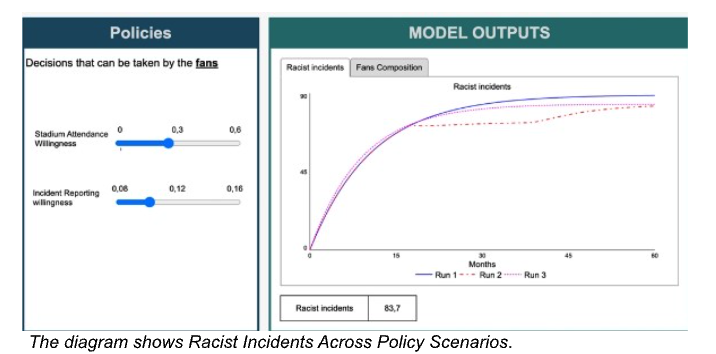
The findings underline the need for systemic, long-term interventions rather than isolated anti-racism actions. To support this, the Interactive Learning Environment has been developed as a hands-on space where stakeholders can explore anti- racism measures without real-world consequences.
By viewing the system through the perspectives of fans, football clubs, and associations, users can observe ho decisions related to reporting, education, enforcement, and investment interact over
time.
Early simulation results suggest that meaningful declines in racist incidents are driven less by punitive measures alone and more by consistent efforts to build trust, improve transparency, and strengthen educational action. While sanctions can curb behaviour in the short term, lasting impact depends on coordinated engagement across the football ecosystem. The simulations also indicate that sustained anti- racism efforts support long-term value by stabilising attendance, protecting reputation, and reducing costs linked to disciplinary actions and boycotts.
Overall, the project provides a practical, evidence-based tool that helps football stakeholders move from reactive responses to strategic, systemic action.
By making complex dynamics visible and testable, it supports the development of more effective policies for building inclusive and resilient football environment.